
To make it easier to find the information you are looking for, we have grouped frequently asked questions into subject areas. If you can’t find the information you are looking for on this page, you can navigate back to the main Frequently Asked Questions page.

How should drivers make deliveries now St John Street has reopened to traffic?
Delivery drivers in Ashbourne must use the new loading bays to avoid damage to the upgraded pavements on St John Street. We are asking businesses to support the changes by advising their employees and suppliers to use the loading bays provided and to not make roadside deliveries elsewhere along the street. Monitoring and enforcement will be carried out by the County Council’s Civil Enforcement Officers along with local partners including the Police, and County and District Councils. If damage does occur and it can be attributed to drivers of particular vehicles or business premises, then the cost of repair will be recharged to them.
What has changed about the way deliveries are made?
The UK Government funded Ashbourne Reborn Highways and Public Realm project, led by the County Council, has seen a number of changes which are designed to improve the pedestrian experience and reduce the dominance of vehicles in the town centre. Alongside wider pavements and improved crossings, the road through the popular town centre shopping street is now narrower and only wide enough for a single vehicle to pass. This means that vehicles will not be able to park outside of the loading bays without obstructing the flow of traffic. Loading bays have been provided over part of the wider pavements, and delivery drivers must use them for loading and unloading.
Where are the loading bays and how can drivers identify them?
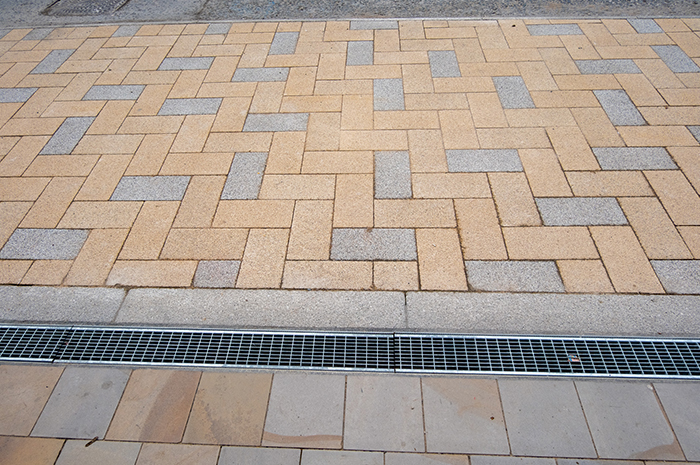
So that deliveries can be made safely, six loading bays have been installed over part of the wider pavements, four on St John Street and two on Dig Street (which is due to reopen to traffic in November). They are marked by a change in paving colour and regulatory signage.
Are there enough loading bays?
The scheme includes more loading bays compared to the layout it is replacing, which was put in place as a temporary arrangement during the pandemic. There are enough loading bays to service business on both sides of the street, although some may have a slightly further distance to walk to receive deliveries. If space is not available to make a delivery, drivers should either seek an alternative or drive round the block again. This is no different to other town centres or other drivers looking for a parking space.
Why can't deliveries be made outside of the loading bays?
To avoid damage, the new loading bays have been strengthened to withstand heavy vehicles. In the past, deliveries were often made directly outside businesses and most drivers parked in the road to load and unload. Over the years, this has caused damage to the pavements where delivery drivers have mounted the kerb outside businesses and properties. If this were to continue, the new paving would rapidly deteriorate and all drivers are discouraged from mounting the newly laid pavements within the town centre, which are not designed for traffic. Monitoring and enforcement will be carried out by the County Council’s Civil Enforcement Officers along with local partners including the Police, and County and District Councils. If damage does occur and it can be attributed to drivers of particular vehicles or business premises, then the cost of repair will be recharged to them.
Why don’t the loading bays have a dropped kerb, and how is it safe for pedestrians to share the space with vehicles?
The Ashbourne Reborn scheme is intended to give pedestrians priority and to reduce the dominance of traffic in the town centre. Loading bays are not for all vehicles to occupy but are there to serve as places to load and unload for limited periods of time. Pedestrians have priority, and vehicles are borrowing the pedestrian space while loading and unloading occurs. Vehicles are not intended to enter the loading bays at speed, so while they don’t have dropped kerbs, the kerbs are splayed to 45 degrees to allow slightly easier access/egress. Once the vehicle leaves the space is freed up for full pedestrian usage.
Can other drivers park in the loading bays?
Loading bays are also not intended for disabled or other parking, and any driver using them incorrectly could receive a penalty charge notice. Other drivers are asked to park in official car parks or on-street parking bays elsewhere in the town and avoid mounting kerbs, which could be dangerous for pedestrians as well as damaging the new paving.
Are loading bays on the pavement safe for pedestrians?
There is enough room for pedestrians to safely use the pavement next to the loading bays. While vehicles load or unload, the pavement will temporarily be reduced in width, similar to the previous pavement width.
Will there be a weight restriction in the town centre when Ashbourne Reborn is finished?
The County Council is proposing the introduction of a 7.5T weight restriction (except for access) on Compton and Dig Street. The alternative route for HGVs will be Station Street, Station Road and Church Street. While the Ashbourne Reborn Programme Board has endorsed the principle of a future weight restriction for the town centre, any decision on this proposal is entirely in the hands of Derbyshire County Council as the Highway Authority and is outside the control of Ashbourne Reborn.
Why are we spending all this when there will still be HGVs in the town every day, this scheme won’t fix the real problem?
The changes that we will deliver through the Levelling Up Fund will make a big difference to how residents and visitors experience the town centre. The improvements to main roads through the centre will make people feel safer and reduce the dominance of traffic and its impact on the town. The scheme won’t remove the heavy vehicles but it will create a much better environment for pedestrians.
Will wider pavements and narrower roads leave enough room for HGVs to travel through without mounting the kerbs and pavements?
To inform the new scheme, designers carried out tracking of kerb lines and radii to ensure that HGVs can travel through the area without having to mount the kerb or pavement.
Will the materials used in the scheme withstand the HGVs that drive through Ashbourne?
So that delivery vehicles don’t obstruct the flow of traffic, loading bays will be provided over part of the wider pavements and the pavement will be designed accordingly to accommodate HGV overrun. Elsewhere, the design of the scheme ensures that HGVs can travel through the area without having to mount the kerb or pavement, therefore areas of the pavement that are not designated loading bays are not designed to cater for HGV traffic. The carriageway will be resurfaced and localised deep patching will occur where areas of failed carriageway are present.
Wouldn’t this money be better spent on the relief road?
The rules for round two of the Levelling Up Fund (LUF) meant that we could not have used this bid to secure investment for the relief road. It was never an option for us to bid for that project; instead we put a lot of time into considering which projects would stand the best chance of success given the LUF rules and process.
How does this affect the plans for the relief road, does this mean that it won’t be happening?
Derbyshire County Council are continuing to develop the case for the relief road and that work will carry on regardless of the Levelling Up Fund projects. The success of the LUF bid won’t reduce our chances of securing funding for the relief road.
Links to other FAQ pages
This page includes answers to general questions we have received about HGVs and relief road. We also have pages with answers to questions about: Parking, Traffic management and diversions, Plans for the Market Place, and general questions about Ashbourne Reborn.